


A corseted waist in ready-to-wear is not a shrunken version of a costume bodice. It is a calibrated structure: fabric panels are cut to exacting curves, stabilized against gravity, and eased to the body so the garment holds its line while the wearer breathes. In our atelier, we build this waist the way a mason sets an arch—each piece must bear tension in the right direction, or the whole silhouette collapses.
For Collection II: Rose Petals, the impulse was to reclaim the rose from the merely pretty. We wanted the petal’s softness, but also the thorn’s resolve. The corseted waist became the point where these two forces meet: layers of silk organza and cotton poplin are gathered into a sharp, contained line that refuses to dissolve into decoration. The rose’s narrative of strength runs through every seam.
What does the pattern geometry of a corseted waist look like?
The foundation is panel geometry. Instead of relying on a simple side-seam cinch, we divide the bodice into vertical panels that radiate from the waistline like ribs from a spine. Each panel carries a specific amount of shaping: the center front and center back panels remain almost straight, while the side-front and side-back panels curve inward to absorb the difference between bust, waist, and hip.
- Panel distribution: More panels create a smoother curve but also more seams. Depending on the fabric’s body and the desired line, we work with six to eight panels, balancing clean circumference reduction against seam bulk.
- Seam-line geometry: Princess seams and waist seams are plotted so the seam allowance can be trimmed and notched at the tightest part of the curve. Without this, the waistline will not lie flat against the body.
- Ease calculation: We add a narrow, measured amount of wearing ease at the waist—enough for breath and sitting, never so much that the line goes slack. That ease is distributed across the panels according to grain and tensile behavior, recorded on the pattern card for each size.
- Grain control: Panels are cut on the straight grain where stability is needed, and only on the bias where we want controlled give. A corseted waist cannot rely on stretch to fit; it must be engineered to fit.
How are interfacing, boning channels, and stabilizers chosen and placed?
The shell fabrics of Rose Petals—silk organza, cotton poplin, and linen-silk blends—have memory and breath, but little resistance to creasing or horizontal pull. To make them stand like architecture, we add internal architecture, carefully matched to each cloth’s temperament.
- Interfacing: Cotton poplin accepts a crisp woven fusible at the facing and waistband. Silk organza, which can bubble under glue, receives a softer sew-in canvas that supports without stiffening the surface.
- Boning channels: Channels are stitched from self-fabric or cotton sateen with a narrow seam allowance, then set into the seams or applied as independent casings. They run vertically at center front, side seams, and sometimes the back, but never directly over the bust point where rigidity would distort the silhouette.
- Boning length: The boning stops short of the waist seam so the waistline can flex as the body moves. A channel that runs too far becomes a hinge; one that stops too soon leaves the waist unsupported.
- Stabilizers: A twill stay tape along the waist seam prevents the line from stretching across wear. In coats and heavier pieces, a hidden grosgrain waist stay acts as an internal belt, carrying the tension so the shell fabric does not have to.
Structure in a corseted waist is not stiffness. It is the right resistance, placed exactly where the body asks for it.
How do we refine fit through iterative prototyping?
Paper patterns are hypotheses. Muslin tests them. In our atelier, the move from flat pattern to finished garment usually passes through three stages of correction, each one finer than the last.
- First toile: A plain cotton calico proves the panel geometry, the seam angles, and the ease distribution. At this stage we look for drag lines, gaping, and stress points where the cloth fights the body.
- Second prototype: We cut again in a cloth whose hand is close to the final—organza for organza, poplin for poplin. A crisp cotton will hold a line that a soft silk will not, so the same pattern must be corrected differently for each fabric.
- Third iteration: Adjustments are made in millimetres at the seams, not centimetres. We shift the angle of a princess seam, shorten a boning channel, or redistribute ease between the side-front and side-back panels until the waistline holds a continuous line when the wearer raises an arm, sits, or turns.
The final test is movement. A corseted waist should feel like held posture, not restraint. There should be no pressure points at the ribs or hip bones, no shifting of the bodice when the arms lift. This is the tempering—the repeated correction that gives the garment both resolve and yield.
Where does this construction appear in Collection II: Rose Petals?
The Rose Petals collection carries its structure quietly. The corseted waist is most visible in the sculptural bustier tops, where the bodice is the garment and the panel seams become the ornament. It also shapes the tailored coats with petal-formed lapels: an internal waist stay gives the coat its hourglass without relying on a belt. In the tiered petal skirts, a stabilized high waistband anchors the volume, turning the waist into the calm center of the silhouette.
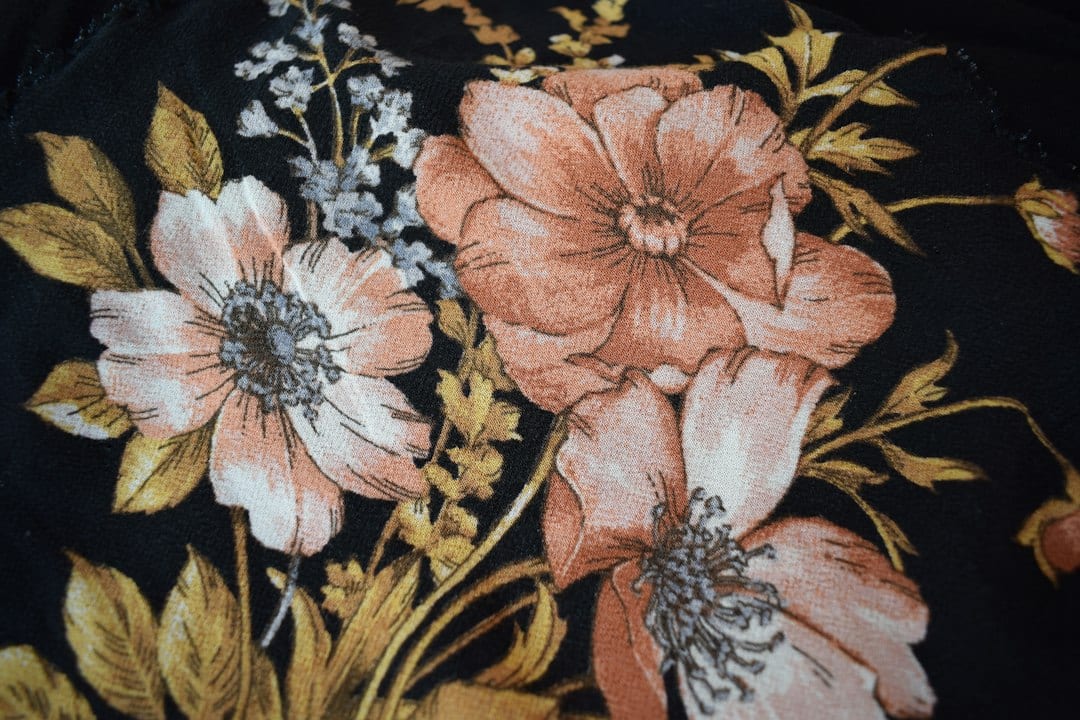
Each fabric in the collection asks for a different treatment. Silk organza needs soft, almost invisible support so its transparency stays honest. Cotton poplin takes crisper interfacing and firmer channels. Linen-silk blends, with their slubbed memory, require a balance between hold and ease so the waist does not crease into a hard line. The result is a family of garments that share one idea: softness does not mean surrender.
How should a structured waist be cared for?
- Store flat or on a padded hanger. Hanging a heavy corseted bodice by thin straps can distort the waistline over time.
- Fasten before storing. Closures carry tension during wear; relieving them in storage helps the fabric and boning keep their shape.
- Clean gently. Silk and silk-blend structured pieces respond best to professional dry cleaning or careful hand washing. Wringing will crease the internal layers.
- Steam from the inside. A light press from the reverse side resets the panels without crushing the face of the fabric.
A corseted waist is not a trap. It is a negotiation between the body and the cloth, between the will to hold a line and the need to move. In Collection II: Rose Petals, that negotiation is what keeps the rose from wilting. The petals may look soft. The waist remembers its shape.
Dili Design Team
Architectural design and fabric craft.
