

A wide-leg trouser is a study in controlled collapse. Let the leg open too quickly, and the silhouette becomes a tent; hold it too narrowly, and the form loses the generosity that makes wide-leg dressing feel like shelter. When we begin draping a new wide-leg shape in the studio, we do not start with trend references. We start with the grain of the cloth, the angle of the fall, and the quiet question of how much room a body needs to move with composure.
How do we calculate sweep, grain, and hem circumference?
We build the leg from the waist down, deciding exactly where width is added and how the hem meets the floor. The first decisions are architectural: the inseam and outseam lengths, the knee line, and the point below the hip where the leg is allowed to open.
The sweep is the gradual increase in width from knee to hem. We develop it by slashing the trouser block and spreading the panels on paper until the leg falls in a clean column rather than a cone. Too little sweep and the trouser reads as a straight leg; too much and the hem brushes the shoe, catching at each step. We test the opening by walking the sample across the studio floor, watching where the fabric breaks over the instep and whether the hem returns to level after movement.
Grain direction keeps this column honest. We keep the center-front and center-back crease lines close to the straight grain so the leg hangs with structural intent. At the side seams, we allow the cloth to fall slightly off-grain, letting it yield around the hip without twisting. If the grain is misaligned, the trouser will spiral around the leg or pull toward one side after a few hours of wear.
The hem circumference is the final calibration. A wide hem needs weight to behave. We finish ours with a deeper, cleanly pressed allowance that anchors the leg without stiffening it. The hem must be trued so it reads level when the body is still and fluid when the body moves.
How do fabric weight and drape coefficient shape movement?
They determine whether the leg sways, floats, or stalls. Drape coefficient describes the ratio between a fabric’s stiffness and its willingness to fall. A high coefficient means the cloth stands away from the body; a low coefficient means it pools and clings. Linen sits in the middle: it has enough body to hold a fold, enough weight to drop vertically, and enough memory to return to shape after being disturbed.
When we evaluate a linen for wide-leg trousers, we watch how the swatch behaves in motion. We lift it, release it, and observe the speed at which the fold settles. A heavier linen falls in crisp planes and resists the wind that enters the leg while walking. A lighter cloth bellies outward and recovers slowly, making the silhouette feel restless.
During wear, the inner and outer panels of the trouser move at different rates. The outer panel swings; the inner panel follows. The drape coefficient governs the amplitude of that swing and how quickly the leg returns to stillness. We refine the sweep and hem depth until the movement feels deliberate rather than accidental.
How do we balance volume at the waist and hip?
By placing fullness where it descends, not where it widens. A wide-leg trouser gains its authority from a high, contained waist and a leg that opens below the fullest part of the hip.
We anchor the waistband at the natural waist and release volume through soft pleats or controlled darts that open below the hip line. The hip circumference is kept close enough to preserve the body’s vertical axis; the width begins lower, so the silhouette elongates rather than expands. If the side seam bows outward at the thigh, we shift fullness toward the inseam or reduce the front pleat depth until the line falls straight.
Proportion is a conversation between three measurements: the waistband height, the hip ease, and the hem sweep. We compare the front and back views on the form repeatedly, because a wide-leg trouser that looks balanced from the front can still sag or pull from the side. A curved waistband and a subtle back yoke help the waist lie flat while the leg flows freely below.
What intent guides Dili’s wide-leg cuts?
They are an argument for quiet strength — structure tempered by movement. Dili’s name, 砥砺, refers to the tempering and sharpening of stone. That philosophy asks for garments that are both firm and yielding: a vertical line that suggests determination, a drape that suggests resilience.
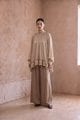
Our ZBM25DLPT33 Autumn Drape Linen Loose Wide-Leg Pants carry this intent in their construction. The high waist holds the silhouette; the natural textured linen breathes and ages; the roomy leg moves with the body rather than against it. Standing still, the trouser reads as architecture. Walking, the folds shift like ink settling on rice paper.
The form interacts with the wearer. It does not impose a shape; it makes room for her stride, her stance, her pause. In this balance between precision and flow, we see the Dili woman: deliberate, unhurried, quietly unyielding.
Caring for linen wide-leg trousers
Linen is honest. It wrinkles, softens, and develops a patina that records the wearer’s movement. To keep the silhouette intact:
- Wash in cold water on a gentle cycle, or hand-wash, to preserve the fiber’s tensile strength.
- Dry flat or hang from the waistband, allowing the leg to fall naturally into its creases.
- Steam while slightly damp rather than pressing the fabric hard; the folds will settle on their own.
- Store hung by the waistband so the grain remains true and the hem does not curl.
“A well-draped wide-leg trouser does not shout. It holds the floor, yields to the stride, and returns to stillness.”
That return to stillness is what we reach for each time we pin a new wide-leg shape. The trousers must do more than cover the leg; they must accompany it. In the space between structure and flow, we find a garment that has been tempered — cut, tested, and refined until it moves with quiet intent.
Dili Design Team — Architectural design and fabric craft